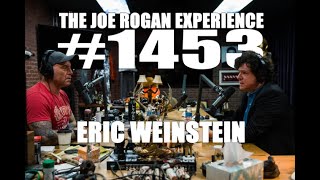
JRE 1203 · November 16, 2018
Eric Weinstein
Who is Eric Weinstein?
Eric Weinstein is a mathematician and economist, and he is also the managing director at Thiel Capital. https://www.youtube.com/ericweinsteinphd
Topics and Timestamps
- 01Eric Weinstein discusses his work at Thiel Capital and his background as a mathematician and economist
- 02Conversation covers unconventional thinking in economics and finance versus traditional academic approaches
- 03Eric explains his perspective on innovation and how institutions can stifle creative problem-solving
- 04Discussion touches on the relationship between theoretical mathematics and practical real-world applications
- 05Eric shares insights about his journey from academia to working in the private sector
- 06The episode explores how established systems resist new ideas and alternative economic frameworks
- ▶Eric introduces his background and role at Thiel Capital0:00:00
- ▶Discussion of how institutions resist unconventional ideas0:15:00
- ▶Eric explains limitations of traditional economic models0:35:00
- ▶Conversation about leaving academia for private sector work0:50:00
- ▶Eric discusses what enables genuine innovation and creative thinking1:10:00
The Show
Joe Rogan sits down with Eric Weinstein, a mathematician and economist currently serving as managing director at Thiel Capital, for a deep dive into unconventional thinking, institutional resistance to innovation, and the intersection of pure mathematics with practical economics. Eric brings a unique perspective to the conversation as someone who has worked both inside traditional academia and within the private sector, giving him insight into how institutions operate and where they fall short.
The discussion centers on how established systems, particularly in economics and academia, are often resistant to new ideas that challenge conventional wisdom. Eric articulates his frustration with how institutions prioritize maintaining existing frameworks over pursuing breakthrough innovations. He discusses the limitations of traditional economic models and how they fail to account for real-world complexity and human behavior. The conversation reveals Eric's belief that the most interesting problems exist outside the boundaries of what mainstream institutions are willing to explore.
Eric shares his perspective on why talented people often leave academia for the private sector, particularly when working with figures like Peter Thiel who actively encourage unconventional thinking. He discusses how Thiel Capital operates differently from traditional investment firms by being willing to take intellectual risks and explore ideas that others dismiss. The conversation touches on the importance of having spaces where heterodox ideas can be developed and tested without the constraints of institutional politics or peer pressure to conform.
Throughout the episode, Joe and Eric explore how innovation actually happens and why it's so rare in established institutions. They discuss the psychological and structural barriers that prevent organizations from truly embracing radical new thinking. Eric emphasizes that true innovation requires not just smart people, but an environment where those people have the freedom to pursue unconventional paths without fear of professional repercussions.
Best Quotes
“Institutions are fundamentally conservative in nature”
— Eric Weinstein
From the JRE 1203 conversation with Eric Weinstein.
“The most interesting problems exist outside the boundaries of what mainstream institutions are willing to explore”
— Joe Rogan
From the JRE 1203 conversation with Eric Weinstein.
“True innovation requires freedom from institutional constraints”
— Eric Weinstein
From the JRE 1203 conversation with Eric Weinstein.
“Economics as currently taught fails to account for human reality”
— Joe Rogan
From the JRE 1203 conversation with Eric Weinstein.
“Peter Thiel's approach to innovation is fundamentally different from how traditional institutions operate”
— Eric Weinstein
From the JRE 1203 conversation with Eric Weinstein.