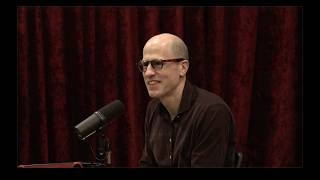
JRE 1350 · September 12, 2019
Nick Bostrom
Who is Nick Bostrom?
Nick Bostrom is a Swedish philosopher at the University of Oxford known for his work on existential risk, the anthropic principle, human enhancement ethics, superintelligence risks, and the reversal test.
Topics and Timestamps
- 01Nick Bostrom discusses existential risk and why humanity should take seriously the possibility of civilizational collapse or extinction
- 02The simulation hypothesis is explored: the philosophical argument that we might be living in a computer simulation created by advanced beings
- 03Bostrom explains the anthropic principle and how our existence as observers shapes what we can know about the universe
- 04Discussion of superintelligence risks and the challenge of creating AI systems aligned with human values
- 05The reversal test is presented as a philosophical tool for evaluating whether improvements to society are actually beneficial
- 06Human enhancement technologies and the ethical implications of cognitive and physical augmentation are debated
- ▶Bostrom explains the simulation hypothesis and the philosophical reasoning behind it0:10:30
- ▶Discussion of existential risk and why small probabilities of extinction matter0:25:15
- ▶The anthropic principle explained and its implications for understanding our universe0:38:45
- ▶Bostrom discusses AI alignment problems and superintelligence risks0:52:20
- ▶Introduction and application of the reversal test for evaluating societal improvements1:15:00
The Show
JRE 1350 brings Swedish philosopher Nick Bostrom to the table to dig into some of the biggest ideas about existence, risk, and the future of humanity. Bostrom is basically the guy who made people seriously consider that we might be living in a simulation, and he's got plenty more existential stuff to unpack.
The conversation kicks off with Bostrom laying out why existential risk is actually worth thinking about. It's not doom and gloom for the sake of it, but rather a serious philosophical and practical consideration about how humanity could face genuine extinction-level threats. He breaks down how even small probabilities of catastrophic outcomes matter when we're talking about the existence of our entire species and potentially trillions of future beings. Joe gets into it because it's the kind of deep philosophical stuff that actually has real implications for how we should structure society and technology.
Bostrom's simulation hypothesis gets its time in the spotlight, and he walks through the logic that's made this idea so culturally significant. The basic argument is pretty wild when you think about it: if civilizations can create detailed simulations of past universes, then statistically we're probably living in one of those simulations rather than in the base reality. It's the kind of thing that sounds like a mind bender but actually has legitimate philosophical weight behind it.
They dig into the anthropic principle, which is basically the idea that what we observe about the universe is constrained by the fact that we exist to observe it. This shapes everything from why the universe seems fine-tuned for life to how we should think about our own place in reality. It's abstract stuff but Bostrom makes it accessible without dumbing it down.
The conversation shifts to superintelligence and AI alignment, which is where things get really practical. Bostrom explains why creating an AI system that's both superintelligent and aligned with human values is such a monumental challenge. It's not just about making AI smart, it's about making sure that when it gets smart enough to shape the world, it's trying to do things we actually want. He discusses how even small misalignments in what an AI system values could lead to catastrophic outcomes.
Bostrom introduces the reversal test as a way to think about whether changes we make to society are actually improvements. The basic idea is that you flip something around and see if the opposite would be bad. It's a useful tool for cutting through a lot of weak arguments about progress. They apply this to various improvements and enhancements, showing how it can reveal whether we're actually making things better or just assuming we are.
Human enhancement comes up as a natural extension, and Bostrom explores the ethics of making people smarter, stronger, or longer-lived. There's genuine uncertainty about whether enhancing humans is unambiguously good, and Bostrom doesn't shy away from the real tensions and tradeoffs involved. It's not a simple issue of "enhancement is awesome," but rather a complex problem of how to think about changing human nature itself.
Best Quotes
“If we are living in a simulation, the simulators would have the power to pause it, rewind it, edit the laws of physics.”
— Nick Bostrom
From the JRE 1350 conversation with Nick Bostrom.
“An existential risk is one where the entire human future could be destroyed.”
— Joe Rogan
From the JRE 1350 conversation with Nick Bostrom.
“The anthropic principle tells us that what we observe must be compatible with us existing as observers.”
— Nick Bostrom
From the JRE 1350 conversation with Nick Bostrom.
“The alignment problem is arguably the most important problem in the world right now because it concerns what happens when we create superintelligence.”
— Joe Rogan
From the JRE 1350 conversation with Nick Bostrom.
“The reversal test asks: if we reversed this change, would that be worse? If not, maybe the change isn't actually an improvement.”
— Nick Bostrom
From the JRE 1350 conversation with Nick Bostrom.
Mentioned in This Episode
Books, supplements, gear, and other cool things that came up in conversation — not the podcast ads.
Superintelligence: Paths, Dangers, Strategies
AmazonNick Bostrom's book exploring the risks and strategic considerations of creating artificial superintelligence.
The Anthropic Principle
AmazonPhilosophical framework examining how human existence as observers constrains what we can know about reality.
As an Amazon Associate we earn from qualifying purchases.